Month: March 2026

Mistakes Made When Using An Odds Calculator

People always say that “Practice makes perfect.”

I disagree. 

The truth is that “PERFECT practice makes perfect.”

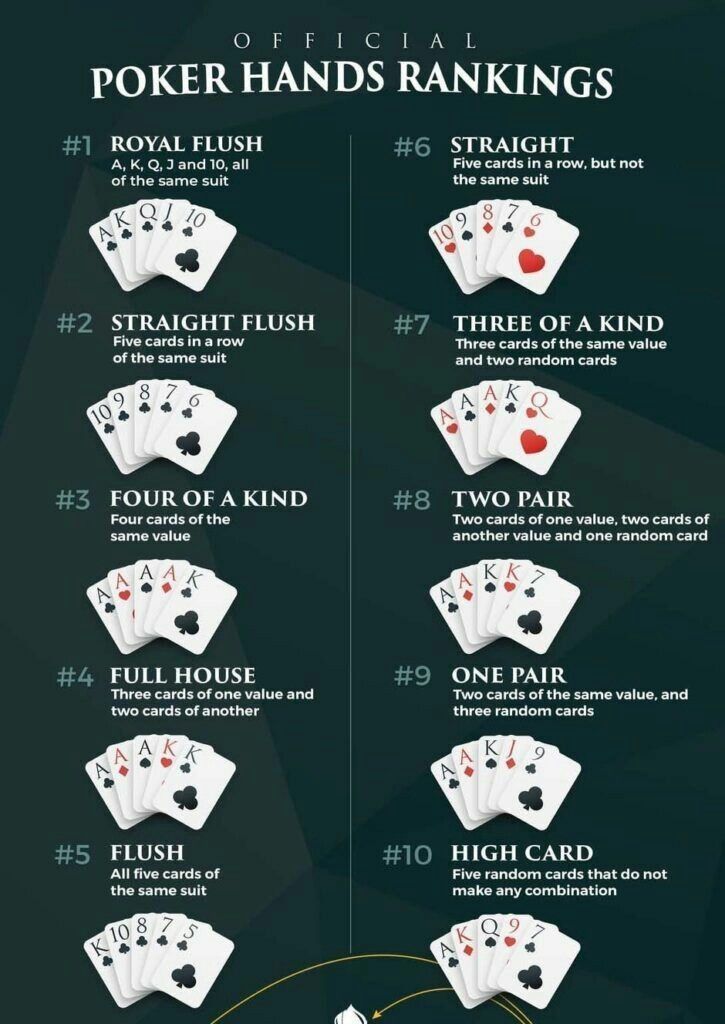
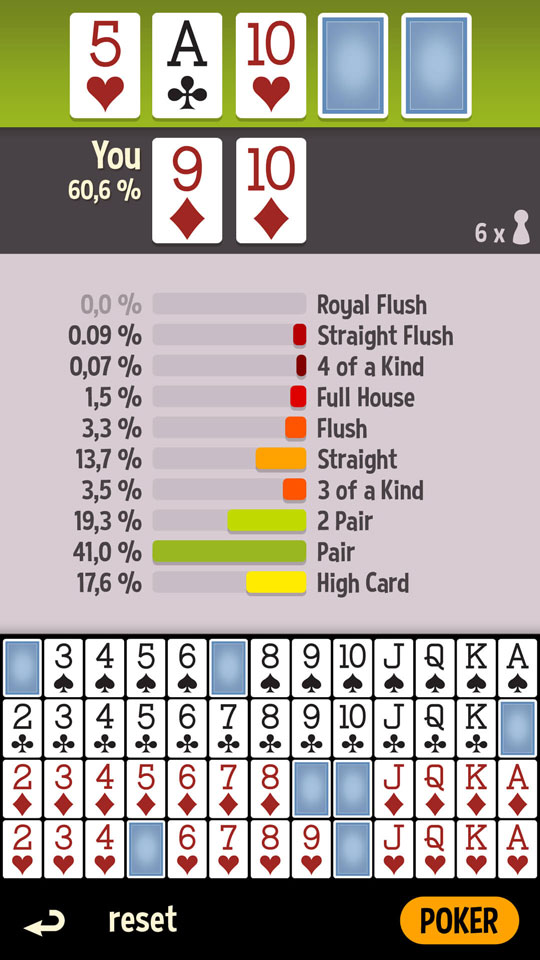
Using an odds calculator at online poker is a crucial way to develop your skills and become a better player…

But I’ve noticed that even though the popularity of calculation programs is booming, many players AREN’T USING THESE TOOLS CORRECTLY.

This “bad practice” can easily cause lost profits, a frustrating learning curve, and unnecessary confusion…

So for this newsletter I want to discuss the seven most costly mistakes players make when using an odds calculator- and how YOU can avoid them.

(If you don’t own an odds calculator yet, you can easily find a free one by searching online)

OK, let’s get started.

MISTAKE #1: Not Bluffing Enough

Poker is a game of ODDS and SKILL… but it’s also a game of PSYCHOLOGY and LUCK.

If you listen to the advice of an odds calculator 100% of the time, yes, you’ll come out ahead. But you don’t want to become a predictable “robot” who only plays favorable odds and never bluffs.

Get my drift?

There are times in every poker game when you’ll want to buy the blinds because you sense weakness, over bet the pot to give off a certain table image, or “bully” the table with your huge chip stack. 

Odds calculators don’t bluff.

And they don’t tell you when to bluff.

That’s why you’ve got to stay alert and make these types of decisions based on your own intuition…


MISTAKE #2: Not Paying Enough Attention To Your Opponents

The right odds calculator can quickly become addictive. It’s easy to get in a bad habit of just listening to its “advice” without paying attention to the game.

This allows you to save time, save energy, and play multiple games at once.

BUT…

Just like bluffing, blindly listening to an odds calculator can be detrimental. It can prevent you from catching important TELLS at the table.

Pay close attention to your opponents so that you spot someone on “tilt”, identify an amateur, and pick up betting patterns.

MISTAKE #3: Not Considering “Likely Odds”

Let’s say you’ve got pocket Queens. You make a pre-flop raise of 3x the big blind and get four callers (at an 8-man table).

The flop hits: A-A-K

What a TERRIBLE flop, right? You figure one of your four opponents MUST have an Ace… or at least a King. And that means all you can hope for on the turn or river is a Queen.

If someone throws out a sizeable bet in this situation, you would fold… because you know you’re beat.

What’s interesting is that a “primitive” odds calculator would tell you that you have a STRONG hand: two pair with a great kicker. And it would probably tell you to call any bets… or even raise.

Crazy, huh?

You see, here’s the thing: Most odds calculators only look at YOUR hand… and don’t try to “deduce” what your opponents might have. They don’t look at what’s “likely”.

You and I both know that the only way someone would call a pre-flop raise of 3x the big blind is if they have something good… like an Ace. But an odds calculator that just pays attention to your cards has no idea.

Some “calculators” are different. Some don’t look at what’s “likely” and what’s not. It should take a look at those four players who stayed in the pot and calculate the likelihood that one of them is holding an Ace or a King… given all the possible conditions.

SO CHOOSE YOUR ODDS CALCULATOR WISELY!

Don’t download an odds calculator that doesn’t do “likely odds”, otherwise you’re just asking for trouble.


MISTAKE #4: Relying Too Much On Odds During “All-In” Plays

In no limit Texas Holdem there is no restriction to how much you can bet. This makes the use of an odds calculator more tricky in this game type.

For instance, let’s say there’s $20 in the pot and your opponent decides to go all-in for his entire stack of $480.

You have to make a decision to call or fold.

The “pot odds” in a situation like this aren’t very good. The reason is because there’s such a small amount in the pot.

In this situation, however, pot odds don’t mean much. Your decision shouldn’t be based on “math”… it should be based on WHETHER YOU THINK YOUR OPPONENT HAS A BETTER HAND.

An all-in situation is so “disproportionate” that odds aren’t really relevant… so don’t get too caught up in

them.


MISTAKE #5: Mis-Interpreting Odds Information When Playing Heads-Up (Or Short-Handed)


With just 2-3 players at the table, chances are NO ONE will get good cards. At this stage in the game, winning is more about bluffs and reading opponents.

Proof of this is the fact that most heads-up hands never get to “show down”. Someone almost always folds BEFORE the river.

Therefore, the odds of “winning by river” aren’t as relevant in this type of situation. Who cares if you have 7-2 offsuit? All that REALLY matters is what your opponent THINKS you have.

When I get heads-up, I don’t pay attention to the “hand strength” percentage or “odds by river” on my odds calculator.


Instead, I pay attention to the “odds on next card” feature, because that’s what is IMMEDIATELY relevant.

MISTAKE #6: Not Adjusting The Odds To Your Personal Style

When you download an odds calculator, make sure it fits your personal “style” of play. If you’re a loose pre-flop player, you don’t want your odds calculator constantly telling you to “play tight and fold”…

Instead, you want your odds calculator to be “loose” and simply show you when you’re deviating in the wrong manner.

Most Calculators feature “play settings” that you can customize for your own needs and preference.

(These settings apply both to pre-flop and post-flop play.)

This is also very useful depending on your game type. For instance, I set my pre-flop settings to be extremely tight in large multi-table tournaments… because my strategy is to sit back and be very patient.

But in a shorthanded Sit and Go, I do exactly the opposite, because “loose” hand selection is required to avoid getting blinded out.


MISTAKE #7: Using The Wrong Odds Calculator


An odds calculator is only useful if it has the FEATURES YOU NEED and if you USE IT RIGHT.

Avoid the common mistakes we’ve just discussed and you’ll be well on your way to maximizing your online poker profits.

The next step is to simply get the BEST odds calculator possible.

I’m not giving my recommendation, as you should choose a calculator according to your needs and game-play style… it also needs to have all the features we’ve just discussed… and dozens more.


Hopefully, by using a calculator and applying the tips I gave you above…  it’ll help you make more money at online poker.

How To Memorize Odds… Fast!

How To Memorize Odds… Fast!


*** CONVERSATION WITH A FRIEND ***

>>> MY FRIEND:

“I usually calculate the odds in percentages using a simple formula for calculating outs. It works well up to a high amount of outs, such as 15, where a decision is usually easy anyway.

You probably know what I mean, but what you do is take the amount of outs and times them by 2 and add 1, this is the chance you will make your hand on the turn if on the flop or the river if on the turn…

Then it’s just a matter of seeing if this percentage is higher than your bet or implied odds percentage.

What are your thoughts on this approach?”

>>> MY THOUGHTS:

Great point…

I actually LOVE this method for calculating odds, because it’s fast and EASY.

However, just like anything else, it has some pitfalls…

So basically, what you’re saying is that you can calculate the PERCENTAGE CHANCE you have of making your hand by DOUBLING the NUMBER OF OUTS and adding one:

(OUTS X 2) + 1 = % of getting a card you need

Remember, “outs” refers to the number of cards in the deck that will complete (or “make”) your hand.

For example, let’s say you’re holding J-10 and the board reads:

8-9-2

That means either a seven or a Queen will complete your straight. Since there are four sevens and four Queens in the deck, you have EIGHT OUTS.

OK… so let’s take a look at how this works:

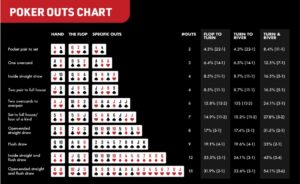
First, let me give you the REAL percentages for each situation. I’ve created a chart.

The first column is how many OUTS you have. The second is your chance of hitting on the TURN card. And the third column is your chance of hitting on the RIVER card.

OK, so here’s the chart:

————————-

OUTS    TURN      RIVER

1      2.13%      2.17%

2      4.26%      4.35%

3      6.38%      6.52%

4      8.51%      8.70%

5      10.64%    10.87%

6      12.77%    13.04%

7      14.89%    15.22%

8      17.02%    17.39%

9      19.15%    19.57%

10    21.23%    21.47%

11    23.40%    23.91%

12    25.53%    26.09%

13    27.66%    28.26%

14    29.79%    30.43%

15    31.91%    32.61%

16    34.04%    34.76%

17    36.17%    36.96%

18    38.30%    39.13%

19    40.43%    41.30%

20    42.55%    43.48%

21    44.68%    45.65%

————————-

As you can see, the formula holds true… for the most part.

If you have three outs or fewer, there’s really no need to add one.

But then again, if you have three outs or fewer, you probably shouldn’t be calculating odds… you should be FOLDING instead!

And if you have more than ELEVEN outs, you should probably add TWO, instead of one.

So… to break it down:

1-3 Outs: Outs x 2 = % of hitting

3-11 Outs: (Outs x 2) + 1 = % of hitting

12+  Outs: (Outs X 2) + 2 = % of hitting

So already we’re getting kind of complicated, and these aren’t even giving us EXACT numbers. 

However… here is why this simple little formula is SO POWERFUL:

For the most part, in REAL LIFE poker situations, the times when you want to calculate odds are in situations where you have about 3-11 outs.

Think about it… in order to have MORE than eleven outs, you’d have to have something like an open-ended straight draw AND a flush draw. And that’s a situation where you should probably be aggressively BETTING or RAISING… not doing math.

OK… so now you know how to QUICKLY and EASILY figure out the odds of making your hand. What REAL VALUE does this add to your game?

The answer is, “Not much.”

You must know how to APPLY this knowledge to bet sizes… that way you can make the right decision on whether to call, raise, or fold.

*** HOW TO CALCULATE THE “BETTING PERCENTAGE” ***

So now we need to learn how to calculate “betting percentage”. Luckily, this is very simple.

The two numbers you need to compare are:

  1. Bet size
  2. Pot size

The FORMULA is this:

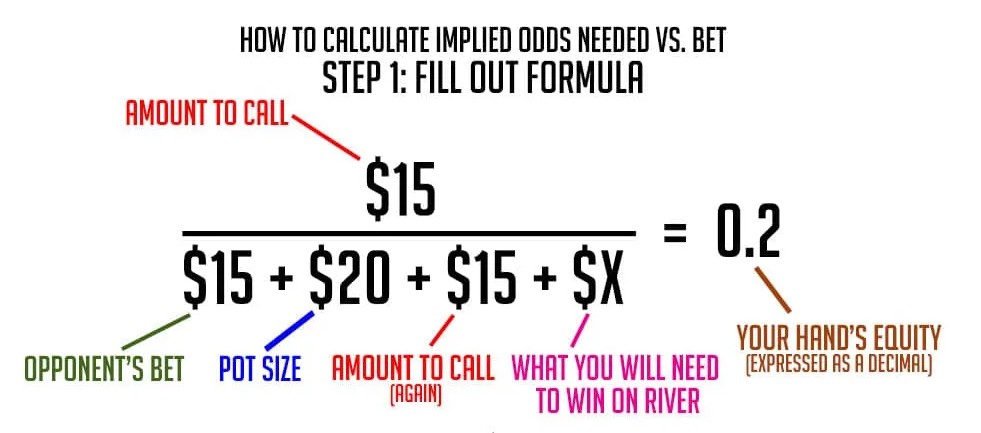
Bet Size / (Pot Size + Bet Size)

For example, let’s say there’s $90 in the pot and the bet is $10. The betting percentage would be $10 divided by $100 ($90 + $10)… or 10%.

If you were looking at it strictly in terms of odds, you’d say your chances were 90:10.

90:10 means you’d miss 90 times and hit 10 times. That’s a total of making it 10 times out of 100 times, which equals 10%.

Now… the FINAL part to all of this is to compare your HAND ODDS to your BETTING ODDS.

If you have a higher percentage chance of MAKING your hand than the betting percentage, you should call…

Let’s look at some examples to make sense of all this madness…

Example:

You’ve got A-2 of diamonds and the flop hits:

5d-Qd-Ks

That means there are two diamonds on the board and two in your hand… so you’ve got the nut flush draw.

You’re on the button. There’s $40 in the pot from before the flop. Don bets $20 after the flop, and three players call.

The action is on you.

So the pot size equals $120, and you need to decide whether to call or not.

If you based your decision strictly on odds, here’s how it would look:

You have nine OUTS… since there are thirteen diamonds in the deck and you already see four of them (13 minus 4 = 9).

So we plug NINE into our handy formula…

9 x 2 = 18

Add 1 = 19% chance of making the flush 

Now… if we look at the chart (we don’t need to), we see that the real percentage is 19.15%.

Presto. Works like a charm.

Now we just need to compare the bet size and pot size to find our “betting percentage”.

The bet size is $20 and there’s $120 in the pot.

So we divide $20 by $140 ($120 + $20).

We don’t even need to do the math. We just need to figure out if it’s BIGGER or SMALLER than 19% (which can be rounded to 20%).

Obviously, 20/140 is smaller than 20%.

The conclusion?

Well, that means our odds of GETTING another diamond and completing our hand are HIGHER than the betting percentage.

This means our pot odds are GOOD. We should call or raise… but not fold.

OK, now for another quick example:

Let’s say we’ve got K-J of spades and the flop hits:

Ah-10d-4c

No spades… but we have an inside straight draw. All we need is the Queen.

Let’s use the same numbers from the last example:

Pot Size = $120

Bet Size = $20

Should we fold or call?

20/140 equals 1/7. We need to figure out if our odds of hitting our inside straight are higher or lower.

Well, since the only card that can really help us is a Queen, we have FOUR outs (the four Queens).

So we double the four and add one…

(4 x 2) + 1 = 9% of getting our Queen on the turn.

The REAL percentage is 8.51%. Pretty close.

So what’s bigger… 1/7 or 9%?

The answer is 1/7.

I always just round numbers to keep it simple. In my mind, 9% is about 10%, which would be 1/10. Obviously, 1/7 is higher than 1/10.

So that means our betting percentage is higher than our hand odds… which is bad.

So we fold.

In order to call, the betting percentage would have needed to be LOWER than 9%. And as you know, that’s VERY RARE.

So… that’s it. That’s the “quick and dirty” way to calculate pot odds. Here’s the 3-step review:

  1. Double your outs and add 1. This equals your approximate percentage of “hitting”.
  1. Divide the bet size by the pot size added to the bet size. (Bet Size / [Pot Size + Bet Size])
  1. Compare the “hand odds” to the “bet odds”. If the hand odds are higher, you should stay in the hand. If the hand odds are smaller, get out.

That’s it.

At first, some of this may seem like an awful lot of work and effort… and requires extra THINKING.

But if you’re serious about poker, you’ve got to try these types of things. What you’ll discover is that after using this stuff for a little while, it all becomes NATURAL in no time.

And soon you’ll never have to actually do ANY of this.

For example… after figuring it out a couple times, you’ll quickly learn that you should NOT chase inside straights.

It’s not worth it.

Also, you shouldn’t stay in a hand with just an Ace high hoping to hit top pair (unless it’s a heads-up match or something).

And so on.

But the BAD NEWS is that calculating odds doesn’t always give you clear-cut “answers”. Odds are just another piece of the puzzle… to be added to your poker “weapons”.

In the first example I shared with you, we were on the nut flush draw with multiple players in the hand. This is a situation where the IMPLIED ODDS are so enormous that the “real” odds don’t matter.

Because think about it: If you hit your flush, someone ELSE probably hit it too… except you’ll have the NUTS. This means you’re very likely to get someone’s ENTIRE chip stack.

Also… odds don’t tell you whether to CALL or RAISE. As you know, raising is a key part of the game, and can often buy you a “free card” while on a draw.

And in the same way, it’s not even really “possible” to calculate the exact number of OUTS or the exact POT SIZE.

For instance… if there are three opponents in a hand and two diamonds on the board, you’d better believe SOMEONE ELSE is holding two diamonds. So you don’t REALLY have nine outs… since more than four diamonds are being used.

If you aren’t last to act, the exact pot size is unknown because you DON’T KNOW what the player(s) behind you will do. They may fold, they may call, or they may RAISE.

These are the EXACT reasons why the game of Texas Holdem is so complex and unpredictable… and exciting. And it’s also why I recommend using a tool like Holdem Genius.


+381601332579 Instagram Telegram WhatsApp

© 2001-2025 - RunYourOwnPokerSite.com
All Rights Reserved.

Scroll to top