Author: ryops

Stop Getting Burned On Flush And Straight Draws

Intro: “Flush” definition and basics explained

For start, let’s remind ourselves about the basics:

  • flush (definition, click to open an external link from Wikipedia)
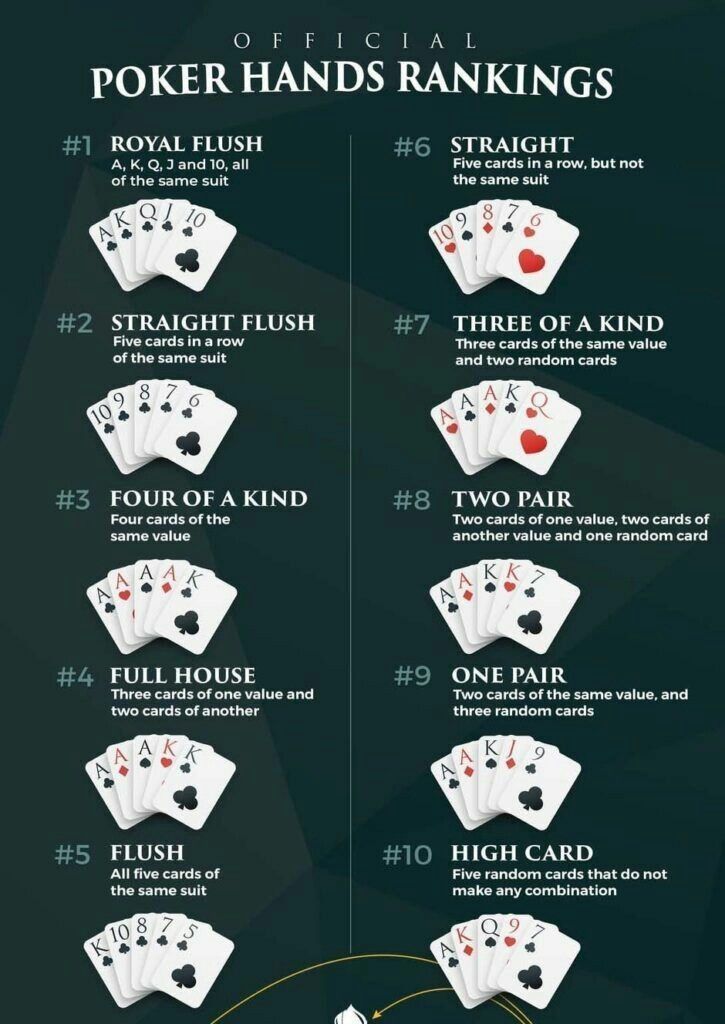
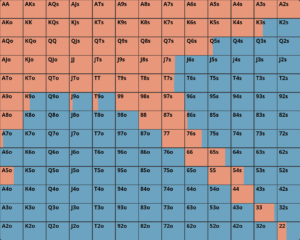
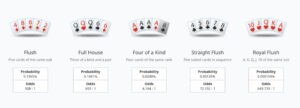
  • possible poker hands combinations; you can check out the image below, or click it and get re-directed to a interesting blog article, which brought up all possible hand strength variations accross all poker game types:


Topic: Stop Getting Burned On Flush And Straight Draws

Have you ever lost a huge pot because you had a flush draw or straight draw and didn’t catch the card you needed?

It’s happened to all of us.

And frankly, it sucks.

Because when you’re on a draw, you’re just ONE CARD AWAY from raking in a ton of chips.

And you WANT to keep calling everyone else’s bets, in hopes that your card will pop out on the turn or river.

Am I right?

Of course, what ends up happening is you have to put a ton of your chips in the middle… just to call everyone else’s bets.

That makes you pot-committed… and if you DON’T catch your card, you’re screwed.

Now let me ask you…

Wouldn’t it be WONDERFUL if every time you were on a draw all the other players would CHECK around?

That way you didn’t have to risk any chips, and could bet only after you KNEW for sure whether or not you caught your card.

That sure would be nice, wouldn’t it?

AND…

What if there was a way to STILL WIN THE HAND… even if you DIDN’T catch your card?

That’d be nice too, huh?

Luckily, there IS a technique you can use to make BOTH of these things happen.

Let me show you how…

OK, so let’s say I’m at an 8-person no limit table and I’m sixth to act.

I’m dealt a 5-6 of diamonds.

Villain#1 comes out firing with a $10 pre-flop bet. Villain#2 and Villain#3 both call.

Now it’s on me.

I love suited connectors… especially busting my opponents with them unexpectedly, so I jump in and call.

The players behind me muck their cards right away… scared to death of so much action.

The flop hits:

4d-9s-7d

That means I’ve just flopped an open-ended straight flush draw. I couldn’t have asked for a better flop in this situation.

Unfortunately, Villain#1 comes out firing (again) with a no-hesitation bet of $20.

Villain#2 and Villain#3 both FOLD this time…

And the action is to me.

I’m putting Villain#1 on a high pocket pair, or maybe A9 or A7. And he’s figuring the scraps on the board didn’t help anyone, hence the strong bet.

Which puts me in a tough situation.

Think about it… If I CALL, I might miss my flush or straight on the turn card. Then what? Villain#1 will make another strong bet… what will I do then?

And if I call to see the river and miss, then I’ll have just given Villain#1 most of my chips and lost a major hand.

On the other hand, I don’t want to FOLD, because I have a ton of outs and I want to WIN this!

Now let me ask you, what would YOU do in this situation?

Most amateur card players don’t think ahead, and they’d call Villain#1‘s $20 bet. And if they missed on the turn, they’d call another bet to see the river.

And if they missed on the river, they’d probably fold, watch Villain#1 rake in all the chips, and wonder why they “never catch the right cards”.

Now a more skillful player would ANTICIPATE what’s about to happen… and would probably call to see the turn, but then fold if Villain#1 bets again.

And of course, there are always the tight players who would never have played the 5-6 of diamonds in the FIRST place.

So what do I do?

Remember, I’m sitting on 5-6 of diamonds. The board reads: 4d-9s-7d

And Villain#1, who made a strong pre-flop raise, just bet $20 after the flop.

Here’s the answer…

I RAISE!

Not some wimpy raise either… I raise him $40 more to play.

Most players would NEVER think to raise in this situation… but here’s what I’ve done:

  1. I’ve TAKEN CONTROL of the hand and bought myself a FREE CARD when it matters most.

You see, if Villain#1 calls the $40 raise, when the turn hits he’ll CHECK to me.

(Remember what I said at the beginning of this post?)

That means I get to see the turn and river for a total of $40 more, which is a BARGAIN compared to what Villain#1’s next bet would have cost me.

  1. I’m representing possible trips.

Villain#1 now has to wonder whether I called his pre-flop raise with a low pocket pair and just caught trips on the flop.

Or I could be sitting on a high pocket pair and I’m not “phased” by the flop.

  1. I’ve raised the stakes of the hand in MY favor… not his. You see, if I just call Villain#1‘s bets and then hit a 8 of diamonds on the turn, what will happen?

Well, Villain#1 will SEE the three diamonds and the straight possibility, and he probably won’t make any more huge bets or call any huge bets from me.

This way, I’ve raised the stakes $40, which increases MY CHANCES at winning an even bigger pot than if I had just called.

Make sense?

And last but not least…

  1. I’ve given myself a way to WIN even if I don’t catch the straight or flush.


Now I get to see Villain#1’s reaction to my $40 raise…

If I sense weakness, I may decide to BLUFF and buy this pot if I don’t catch my flush or straight.

If I only call Villain#1’s bets the whole way, he would’t fall for this type of bluff. But my raise of $40 will sure get him thinking.

OKAY, BACK TO THE HAND…

Villain#1 shuffles his chips around for a moment, and looks back down at his cards. It turns out he’s holding an A9… so he’s got top pair with the kicker. A good hand, but not a monster by any means.

He calls.

The next card comes out… Queen of spades.

No help.

Villain#1 checks.

THAT WAS IMPORTANT.

This is my “free card” opportunity that my $40 raise bought.

Now I’m in complete control… and feeling pretty good about this hand.

I can check and see the river for free. I’ve still got a lot of outs here.

Or I can bet STRONG and try to scare Villain#1 away.

“One hundred dollars”, I say, as I push a huge stack of red chips into the middle.

True, I only have a Queen high… and the beginner card player may think this type of play is crazy.

But then again, that’s why they’re called “BEGINNERS”.

Anyway…

Villain#1 thinks for a minute and then mucks it.

I rake in a beautiful pot.

Even if Villain#1 had called, I still had a good number of outs.

And if I missed, I could have tried to bluff again.


Now think back to when the flop came out…

After Villain#1 bet $20, what if I had called? (And not raised.)

Well, here’s what would have happened…

The Queen would have came and Villain#1 would’ve immediately fired a huge $80 bet. 

I would’ve had to either call the $80 to see the river, or muck my beautiful straight flush draw.

And THAT, my friend, is why it’s CRUCIAL that you TAKE CONTROL of the betting.

This type of technique allows you to truly DOMINATE THE TABLES and win more money playing poker. Period.

That’s what makes Texas Holdem such a fascinating game… there are just so many scenarios that can occur, and so many special “tricks” and “techniques” you can use to beat the competition.

Of course, you’ll probably never figure them all out on your own… and that’s why I’m here to help.

If you’re serious about taking your card playing skills to the next level, then it’s time you get started on the tables now and become a poker SHARK.

This proven, step-by-step “roadmap” will improve your game TREMENDOUSLY and help you achieve your goals… by TEACHING YOU WHILE YOU PLAY.

Because only by constantly learning new strategies, and reviewing your previous sessions played, it’s the only way you can constantly keep improving your game, and building your BANKROLL!


Good luck at the tables!!!

Why You Shouldn’t Slow Play Big Hands

Intro: Poker Hand Rankings accross all  game types and variations

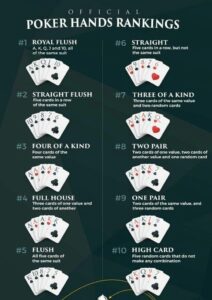
First of all, let’s take a brief look at the possible poker hands combinations; you can check out the image below, or click it and get re-directed to a interesting blog article, which brought up all possible hand strength variations accross all poker game types:


Why You Shouldn’t Slow Play Big Hands

When you get a MONSTER hand, you should NOT slow play it.

Here’s why:

“Slow playing” means that you don’t bet very much, or bet nothing at all, in hopes that your opponent makes a big bet or tries to bluff.

For instance, if you got two Aces before the flop and only called the big blind, you would be “slow playing” your Aces.

Or if you flopped a straight and just “checked”, you would be slow playing your straight.

Does it make sense?

The problem is, most amateurs will slow play their big hands… trying to perform the famous check-raise

maneuver… or trying to “trap” their opponents…

But generally speaking, this is NOT a smart strategy… for two reasons:

  1. Because many poker players will see right through you… and fold the hand as soon as you make your move.
  1. Because you won’t win as much money when you slow play big hands versus betting them.


Let’s talk about the first reason…

The fact is, slow playing big hands will NOT confuse your opponents.

On the contrary, it will actually give them a SOLID READ on you.

Why?

BECAUSE MOST PLAYERS SLOW PLAY MONSTER HANDS.

That’s just the way it is.

You may think you’re being SLY, but you’re really just being STUPID.

I think it’s actually human INSTINCTS to slow play big hands…

Think about it. When someone gets a big hand, what are they thinking in their heads?

They SHOULD be thinking… “How can I get the most money possible out of this pot?”

But what they are REALLY thinking is… “How can I make sure everyone doesn’t fold and this great hand doesn’t go to waste?”

It’s the truth.

Especially since it will often take HUNDREDS of hands before you catch a monster.

And that’s the REAL reason why people slow play big hands…

Because they’re SCARED TO DEATH that if they make a bet, everyone will fold.

So the point is, it is NOT unique to slow play a monster… in fact, it’s what MOST card players do. Especially amateurs.

Now let’s look at the second reason why slow playing a big hand is a bad idea… and that is:

YOU WON’T MAKE AS MUCH MONEY.

The fact is, when you hit a monster, you should bet it. It’s that simple.

Even if you REALLY ARE thinking to yourself, “How can I get the most money out of this pot?”, the answer is to bet it.

Not slow play it.

You’ll win more chips and make more money by betting your big hands… especially when you look at it over a long term perspective.

Let me show you three reasons why:

  1. Usually, one of your opponents will have SOMETHING… whether it’s a bottom pair, wired pair, straight draw… whatever.

This means that you’ll usually get one or more callers for your monster hand… which is “sure money” going into the pot that you’re about to win…

  1. When you slow play big hands, you’re opening yourself up for BAD BEATS. You shouldn’t give your opponents the opportunity to see free cards.

When you let them see free cards, you’re just increasing the odds that someone catches a lucky draw… or the one “miracle” card that can bust your hand. Betting your big hand, instead of letting your opponent get free cards, will narrow down your chances of a bad beat.

  1. Your opponents won’t see it coming. 

Since most players slow play monsters, your opponents will often put you on a BLUFF when you bet your big hand.

And if they think you’re bluffing, they’ll try to come back over the top of you with a raise.

This, of course, gives you yet ANOTHER way to make more money from your hand…

Now… let me talk about the EXCEPTION to this rule. And that is when you get a monster that is SO UNBELIEVABLE…

AND you sense complete weakness at the table.

The most common example of this is 4-of-a-kind. For instance…

Let’s say the flop came out 8,8,2 and you’ve got pocket 8’s.

The other two players check to you.

In this case, it will be smart to just check your big hand, rather than betting.

BUT, you’re not really “slow playing” it.

What you’re ACTUALLY doing is just letting your opponents “catch up” to you.

Since you know the 8’s couldn’t have helped either of your opponents, you want to make sure a turn card comes out… and maybe even a river card… in hopes that someone catches SOMETHING.

If the turn card is a face card, that’s good news for you. Because it means that someone might have made top pair and will be willing to give you some action in the hand.

But besides that, you should NOT slow play your big hands.

Now let’s see a real-life instance where this strategy helped me make more money at the poker table.

Just the other night I was at the riverboat and got dealt AQ. My positioning wasn’t good, but it was the first decent hand I’d seen in awhile, so I raised the pot to 1,500 in chips.

Only one player called me… the man on the button. This guy (we’ll call him “Mike”) is a very good card player. He goes to the casinos every single night… 7 days a week… grinding it out and making his living.

He’s one of the only players at this table that I generally avoid going heads-up with, actually.

So anyway… the flop comes out, and it’s:

Q-Q-3

I’ve flopped a set with an Ace kicker.

I’m first to act. So what do I do?

Most players would slow play… but not me. I come out firing.

I hesitate for like two seconds and then push in 4,000 in chips.

Mike is thinking there is no possible way I’d bet trips like that… so he’s probably putting me on a high wired pair (but not Queens).

Plus, he might think I’m just representing my pre-flop raise with this bet…

So instead of folding, Mike decides to represent the Queens out there… and act as if HE has the trip queens.

“Make it 10,000”, he says aggressively.

Of course, now I’ve got Mike EXACTLY where I want him…

I call his bet.

The turn card comes… it’s a 10.

I check… because I know Mike is going to make a big move on me.

“Make it 10,000”, he says again.

And I call again.

It turns out Mike is sitting on K-10… which means he’s got a pair. This will give him even MORE confidence to try to buy this pot.

Now that I’ve called his bets, however, he’s probably thinking I have Kings or Aces. Which means the only way he can win this pot is to scare me away.

The river hits… and it’s a 3. Which gives me the full house.

I check again, and Mike goes ALL IN with his huge chip stack… thinking he can bully me out of the hand.

I call… and I take down a MASSIVE pot from the seasoned rounder.


And it all started because I DIDN’T slow play my trips. Mike didn’t put me on the three Queens and was willing to push his entire stack into the middle to try to win that pot.

Of course… that won’t happen every time you get a big hand. And trying to confuse your opponent is definitely NOT the only reason to not slow play your big hands.

The reality is, when you bet your big hands you’ll CONSISTENTLY win more pots and make MORE MONEY playing poker…

And if you’d like to discover step-by-step strategies and concepts like this one that will improve your Texas Holdem skills, make sure you stay tuned for the next blog article 🙂

Most of the secrets to poker are CONTRARY to what you’d expect. And it’s only after you learn the REASONING and LOGIC behind these techniques that you’ll be able to take your poker game to the NEXT LEVEL.

Mistakes Made When Using An Odds Calculator

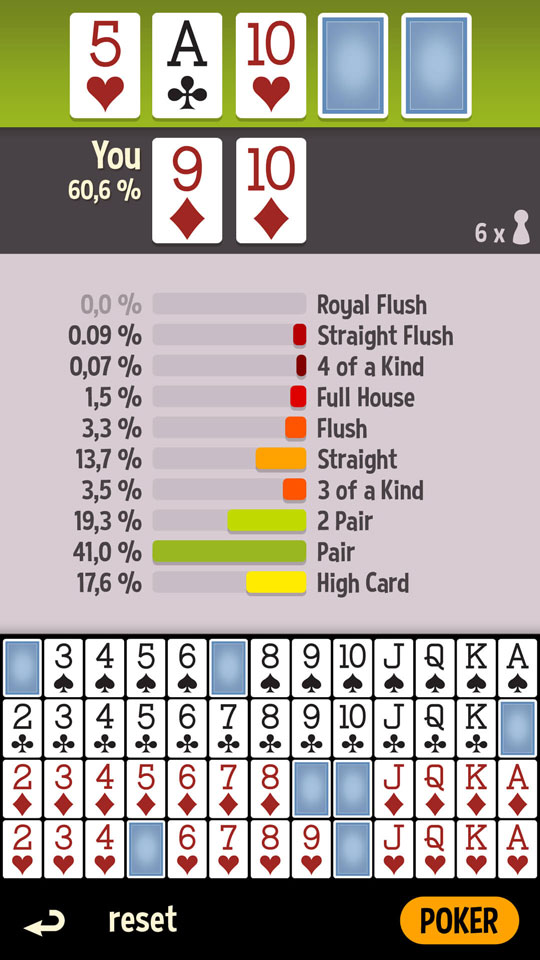
Intro: in the following article, we’ll try to bring up some of the most common mistakes made when using an odds calculator. It is very important to understand the oddds if you want to improve your game, so we will try to point out the most common mistakes you can make using it.

People always say that “Practice makes perfect.”

I disagree. 

The truth is that “PERFECT practice makes perfect.”

Using an odds calculator at online poker is a crucial way to develop your skills and become a better player…

But I’ve noticed that even though the popularity of calculation programs is booming, many players AREN’T USING THESE TOOLS CORRECTLY.

This “bad practice” can easily cause lost profits, a frustrating learning curve, and unnecessary confusion…

So for this newsletter I want to discuss the seven most costly mistakes players make when using an odds calculator- and how YOU can avoid them.

(If you don’t own an odds calculator yet, you can easily find a free one by searching online)

OK, let’s get started.

MISTAKE #1: Not Bluffing Enough

Poker is a game of ODDS and SKILL… but it’s also a game of PSYCHOLOGY and LUCK.

If you listen to the advice of an odds calculator 100% of the time, yes, you’ll come out ahead. But you don’t want to become a predictable “robot” who only plays favorable odds and never bluffs.

Get my drift?

There are times in every poker game when you’ll want to buy the blinds because you sense weakness, over bet the pot to give off a certain table image, or “bully” the table with your huge chip stack. 

Odds calculators don’t bluff.

And they don’t tell you when to bluff.

That’s why you’ve got to stay alert and make these types of decisions based on your own intuition…


MISTAKE #2: Not Paying Enough Attention To Your Opponents

The right odds calculator can quickly become addictive. It’s easy to get in a bad habit of just listening to its “advice” without paying attention to the game.

This allows you to save time, save energy, and play multiple games at once.

BUT…

Just like bluffing, blindly listening to an odds calculator can be detrimental. It can prevent you from catching important TELLS at the table.

Pay close attention to your opponents so that you spot someone on “tilt”, identify an amateur, and pick up betting patterns.

MISTAKE #3: Not Considering “Likely Odds”

Let’s say you’ve got pocket Queens. You make a pre-flop raise of 3x the big blind and get four callers (at an 8-man table).

The flop hits: A-A-K

What a TERRIBLE flop, right? You figure one of your four opponents MUST have an Ace… or at least a King. And that means all you can hope for on the turn or river is a Queen.

If someone throws out a sizeable bet in this situation, you would fold… because you know you’re beat.

What’s interesting is that a “primitive” odds calculator would tell you that you have a STRONG hand: two pair with a great kicker. And it would probably tell you to call any bets… or even raise.

Crazy, huh?

You see, here’s the thing: Most odds calculators only look at YOUR hand… and don’t try to “deduce” what your opponents might have. They don’t look at what’s “likely”.

You and I both know that the only way someone would call a pre-flop raise of 3x the big blind is if they have something good… like an Ace. But an odds calculator that just pays attention to your cards has no idea.

Some “calculators” are different. Some don’t look at what’s “likely” and what’s not. It should take a look at those four players who stayed in the pot and calculate the likelihood that one of them is holding an Ace or a King… given all the possible conditions.

SO CHOOSE YOUR ODDS CALCULATOR WISELY!

Don’t download an odds calculator that doesn’t do “likely odds”, otherwise you’re just asking for trouble.


MISTAKE #4: Relying Too Much On Odds During “All-In” Plays

In no limit Texas Holdem there is no restriction to how much you can bet. This makes the use of an odds calculator more tricky in this game type.

For instance, let’s say there’s $20 in the pot and your opponent decides to go all-in for his entire stack of $480.

You have to make a decision to call or fold.

The “pot odds” in a situation like this aren’t very good. The reason is because there’s such a small amount in the pot.

In this situation, however, pot odds don’t mean much. Your decision shouldn’t be based on “math”… it should be based on WHETHER YOU THINK YOUR OPPONENT HAS A BETTER HAND.

An all-in situation is so “disproportionate” that odds aren’t really relevant… so don’t get too caught up in

them.


MISTAKE #5: Mis-Interpreting Odds Information When Playing Heads-Up (Or Short-Handed)

 

With just 2-3 players at the table, chances are NO ONE will get good cards. At this stage in the game, winning is more about bluffs and reading opponents.

Proof of this is the fact that most heads-up hands never get to “show down”. Someone almost always folds BEFORE the river.

Therefore, the odds of “winning by river” aren’t as relevant in this type of situation. Who cares if you have 7-2 offsuit? All that REALLY matters is what your opponent THINKS you have.

When I get heads-up, I don’t pay attention to the “hand strength” percentage or “odds by river” on my odds calculator.


Instead, I pay attention to the “odds on next card” feature, because that’s what is IMMEDIATELY relevant.

MISTAKE #6: Not Adjusting The Odds To Your Personal Style

When you download an odds calculator, make sure it fits your personal “style” of play. If you’re a loose pre-flop player, you don’t want your odds calculator constantly telling you to “play tight and fold”…

Instead, you want your odds calculator to be “loose” and simply show you when you’re deviating in the wrong manner.

Most Calculators feature “play settings” that you can customize for your own needs and preference.

(These settings apply both to pre-flop and post-flop play.)

This is also very useful depending on your game type. For instance, I set my pre-flop settings to be extremely tight in large multi-table tournaments… because my strategy is to sit back and be very patient.

But in a shorthanded Sit and Go, I do exactly the opposite, because “loose” hand selection is required to avoid getting blinded out.


MISTAKE #7: Using The Wrong Odds Calculator


An odds calculator is only useful if it has the FEATURES YOU NEED and if you USE IT RIGHT.

Avoid the common mistakes we’ve just discussed and you’ll be well on your way to maximizing your online poker profits.

The next step is to simply get the BEST odds calculator possible.

I’m not giving my recommendation, as you should choose a calculator according to your needs and game-play style… it also needs to have all the features we’ve just discussed… and dozens more.


Hopefully, by using a calculator and applying the tips I gave you above…  it’ll help you make more money at online poker.


Online Hold’em Odds Calculator Suggestions (External Links) 

Since it’s essential to review your past poker sessions, you can review what were the odds in a certain hand you played by setting up the same cards in one of the following odds calculators (the links are just suggestions based on author’s personal preferences):

Calculator 1

Calculator 2

Calculator 3


How To Memorize Odds… Fast!

Intro: Poker Odds

In poker, “odds” are the mathematical foundation used to determine if a bet is profitable in the long run. To master them, you primarily need to understand the relationship between Pot Odds (the price of the bet) and Equity (your chance of winning). In this article, we will try to show you how to memorize odds… fast!

To review or learn all possible poker hands combinations; you can check out the link below (clicking it will get you re-directed to a interesting blog article, which brought up all possible hand strength variations accross all poker game types)

Possible Poker Hands Combinations


*** CONVERSATION WITH A FRIEND ***

>>> MY FRIEND:

“I usually calculate the odds in percentages using a simple formula for calculating outs. It works well up to a high amount of outs, such as 15, where a decision is usually easy anyway.

You probably know what I mean, but what you do is take the amount of outs and times them by 2 and add 1, this is the chance you will make your hand on the turn if on the flop or the river if on the turn…

Then it’s just a matter of seeing if this percentage is higher than your bet or implied odds percentage.

What are your thoughts on this approach?”

>>> MY THOUGHTS:

Great point…

I actually LOVE this method for calculating odds, because it’s fast and EASY.

However, just like anything else, it has some pitfalls…

So basically, what you’re saying is that you can calculate the PERCENTAGE CHANCE you have of making your hand by DOUBLING the NUMBER OF OUTS and adding one:

(OUTS X 2) + 1 = % of getting a card you need

Remember, “outs” refers to the number of cards in the deck that will complete (or “make”) your hand.

For example, let’s say you’re holding J-10 and the board reads:

8-9-2

That means either a seven or a Queen will complete your straight. Since there are four sevens and four Queens in the deck, you have EIGHT OUTS.

OK… so let’s take a look at how this works:

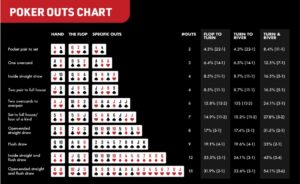
First, let me give you the REAL percentages for each situation. I’ve created a chart.

The first column is how many OUTS you have. The second is your chance of hitting on the TURN card. And the third column is your chance of hitting on the RIVER card.

OK, so here’s the chart:

————————-

OUTS    TURN      RIVER

1      2.13%      2.17%

2      4.26%      4.35%

3      6.38%      6.52%

4      8.51%      8.70%

5      10.64%    10.87%

6      12.77%    13.04%

7      14.89%    15.22%

8      17.02%    17.39%

9      19.15%    19.57%

10    21.23%    21.47%

11    23.40%    23.91%

12    25.53%    26.09%

13    27.66%    28.26%

14    29.79%    30.43%

15    31.91%    32.61%

16    34.04%    34.76%

17    36.17%    36.96%

18    38.30%    39.13%

19    40.43%    41.30%

20    42.55%    43.48%

21    44.68%    45.65%

————————-

As you can see, the formula holds true… for the most part.

If you have three outs or fewer, there’s really no need to add one.

But then again, if you have three outs or fewer, you probably shouldn’t be calculating odds… you should be FOLDING instead!

And if you have more than ELEVEN outs, you should probably add TWO, instead of one.

So… to break it down:

1-3 Outs: Outs x 2 = % of hitting

3-11 Outs: (Outs x 2) + 1 = % of hitting

12+  Outs: (Outs X 2) + 2 = % of hitting

So already we’re getting kind of complicated, and these aren’t even giving us EXACT numbers. 

However… here is why this simple little formula is SO POWERFUL:

For the most part, in REAL LIFE poker situations, the times when you want to calculate odds are in situations where you have about 3-11 outs.

Think about it… in order to have MORE than eleven outs, you’d have to have something like an open-ended straight draw AND a flush draw. And that’s a situation where you should probably be aggressively BETTING or RAISING… not doing math.

OK… so now you know how to QUICKLY and EASILY figure out the odds of making your hand. What REAL VALUE does this add to your game?

The answer is, “Not much.”

You must know how to APPLY this knowledge to bet sizes… that way you can make the right decision on whether to call, raise, or fold.

HOW TO CALCULATE THE “BETTING PERCENTAGE” 

So now we need to learn how to calculate “betting percentage”. Luckily, this is very simple.

The two numbers you need to compare are:

  1. Bet size
  2. Pot size

The FORMULA is this:

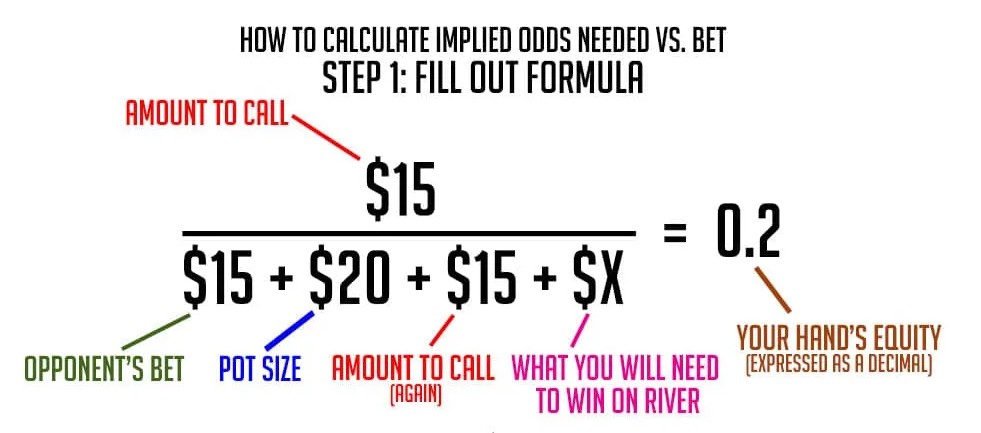
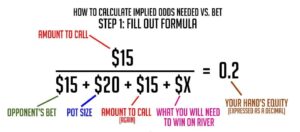
Bet Size / (Pot Size + Bet Size)

For example, let’s say there’s $90 in the pot and the bet is $10. The betting percentage would be $10 divided by $100 ($90 + $10)… or 10%.

If you were looking at it strictly in terms of odds, you’d say your chances were 90:10.

90:10 means you’d miss 90 times and hit 10 times. That’s a total of making it 10 times out of 100 times, which equals 10%.

Now… the FINAL part to all of this is to compare your HAND ODDS to your BETTING ODDS.

If you have a higher percentage chance of MAKING your hand than the betting percentage, you should call…

Let’s look at some examples to make sense of all this madness…

Example:

You’ve got A-2 of diamonds and the flop hits:

5d-Qd-Ks

That means there are two diamonds on the board and two in your hand… so you’ve got the nut flush draw.

You’re on the button. There’s $40 in the pot from before the flop. Don bets $20 after the flop, and three players call.

The action is on you.

So the pot size equals $120, and you need to decide whether to call or not.

If you based your decision strictly on odds, here’s how it would look:

You have nine OUTS… since there are thirteen diamonds in the deck and you already see four of them (13 minus 4 = 9).

So we plug NINE into our handy formula…

9 x 2 = 18

Add 1 = 19% chance of making the flush 

Now… if we look at the chart (we don’t need to), we see that the real percentage is 19.15%.

Presto. Works like a charm.

Now we just need to compare the bet size and pot size to find our “betting percentage”.

The bet size is $20 and there’s $120 in the pot.

So we divide $20 by $140 ($120 + $20).

We don’t even need to do the math. We just need to figure out if it’s BIGGER or SMALLER than 19% (which can be rounded to 20%).

Obviously, 20/140 is smaller than 20%.

The conclusion?

Well, that means our odds of GETTING another diamond and completing our hand are HIGHER than the betting percentage.

This means our pot odds are GOOD. We should call or raise… but not fold.

OK, now for another quick example:

Let’s say we’ve got K-J of spades and the flop hits:

Ah-10d-4c

No spades… but we have an inside straight draw. All we need is the Queen.

Let’s use the same numbers from the last example:

Pot Size = $120

Bet Size = $20

Should we fold or call?

20/140 equals 1/7. We need to figure out if our odds of hitting our inside straight are higher or lower.

Well, since the only card that can really help us is a Queen, we have FOUR outs (the four Queens).

So we double the four and add one…

(4 x 2) + 1 = 9% of getting our Queen on the turn.

The REAL percentage is 8.51%. Pretty close.

So what’s bigger… 1/7 or 9%?

The answer is 1/7.

I always just round numbers to keep it simple. In my mind, 9% is about 10%, which would be 1/10. Obviously, 1/7 is higher than 1/10.

So that means our betting percentage is higher than our hand odds… which is bad.

So we fold.

In order to call, the betting percentage would have needed to be LOWER than 9%. And as you know, that’s VERY RARE.

So… that’s it. That’s the “quick and dirty” way to calculate pot odds. Here’s the 3-step review:

  1. Double your outs and add 1. This equals your approximate percentage of “hitting”.
  1. Divide the bet size by the pot size added to the bet size. (Bet Size / [Pot Size + Bet Size])
  1. Compare the “hand odds” to the “bet odds”. If the hand odds are higher, you should stay in the hand. If the hand odds are smaller, get out.

That’s it.

At first, some of this may seem like an awful lot of work and effort… and requires extra THINKING.

But if you’re serious about poker, you’ve got to try these types of things. What you’ll discover is that after using this stuff for a little while, it all becomes NATURAL in no time.

And soon you’ll never have to actually do ANY of this.

For example… after figuring it out a couple times, you’ll quickly learn that you should NOT chase inside straights.

It’s not worth it.

Also, you shouldn’t stay in a hand with just an Ace high hoping to hit top pair (unless it’s a heads-up match or something).

And so on.

But the BAD NEWS is that calculating odds doesn’t always give you clear-cut “answers”. Odds are just another piece of the puzzle… to be added to your poker “weapons”.

In the first example I shared with you, we were on the nut flush draw with multiple players in the hand. This is a situation where the IMPLIED ODDS are so enormous that the “real” odds don’t matter.

Because think about it: If you hit your flush, someone ELSE probably hit it too… except you’ll have the NUTS. This means you’re very likely to get someone’s ENTIRE chip stack.

Also… odds don’t tell you whether to CALL or RAISE. As you know, raising is a key part of the game, and can often buy you a “free card” while on a draw.

And in the same way, it’s not even really “possible” to calculate the exact number of OUTS or the exact POT SIZE.

For instance… if there are three opponents in a hand and two diamonds on the board, you’d better believe SOMEONE ELSE is holding two diamonds. So you don’t REALLY have nine outs… since more than four diamonds are being used.

If you aren’t last to act, the exact pot size is unknown because you DON’T KNOW what the player(s) behind you will do. They may fold, they may call, or they may RAISE.

These are the EXACT reasons why the game of Texas Holdem is so complex and unpredictable… and exciting. And it’s also why I recommend using a tool like some of the following (see links below).

Online Hold’em Odds Calculator Suggestions (External Links) 

Since it’s essential to review your past poker sessions, you can review what were the odds in a certain hand you played by setting up the same cards in one of the following odds calculators (the links are just suggestions based on author’s personal preferences):

Calculator 1

Calculator 2

Calculator 3

Was This A Bad Beat Or A Bad Play?

Previous Game-play Analysis

Was This A Bad Beat Or A Bad Play? First of all, it is very important, for every poker player, to make analysis of your previous sessions played, comparing the decisions you made, figuring out what you could have done better in certain occasions, therefore improving your future game-play.


I was recently in an online tourney with a $20,000 payout. 5,000 people entered and unfortunately I finished 352nd. I have one hand in that tournament that since haunts me every night before I go to sleep, and I have to replay it in my mind over and over again, I have even dreamt about it.

**Please let me know what (you think) I did wrong so I can give myself a different angle for reviewing my own game-play.**

Alright, the blinds were at 400/800. My stack was about 10k. I get A-J off 1 spot before the button. Everyone folds to me, and since I think A-J isn’t that strong, and it is one of my “unlucky hands”, I only called the BB. The guy on the button called as well, the SB folded, and the BB doubled the bet. So, I said, well, another 800 is OK cause I will probably be getting 5:1 on my money, assuming that the guy on the button calls.

He does, and the flop comes K-A-8. No flush draws are present and the big blind checks to me. I bet about 2,500 as a feeler bet, with top pair to see where I stood in the hand. The guy on the button

goes all-in for his remaining 8,000, I figured he was playing position and I was going to call him.

But, the BB goes all in for his remaining 7,000, and that scared me because he was the original raiser preflop.

knew he didn’t have A-K, but A-Q was a possibility and A-8 was too, as well as a pair of 8s in the hole.

After reviewing in my mind the betting sequences, I folded thinking that one of them had either 2 pair, or trip 8s.

They turned up their cards, and the guy on the button had K-5, and the BB had A-6… I was STUNNED! I could have taken that pot, and the chip lead in the tournament and could have either worked with that lead, or sat all the way to the money, but instead I was forced to later go all in with a moderate hand, and get beat by a pocket pair. 

My logic about the hand seems good, the only mistake I think I made was not raising a considerable amount pre-flop in the position I was in, I think that if I did it and they still called I woulda been pot committed to call and would have won.

The most important thing is to review the sessions played, ie to analyze what you could have done to avoid this, which is crucial to keep the same mistake or bad play from occurring again

There are various online tools which can help you analyze or keep track of your gameplay over the sessions. Most pro players will tell you that analyzing the sessions is the only way to improve your game.

First of all, let’s talk about the strategies that SHOULD have been going through your head at the time.

ON POSITIONING…

I was sitting one seat to the right of the dealer button. In this position, when you get a strong starting hand you want to RAISE and “steal the button” if possible.

This technique is simple. You basically just want the player to your left to FOLD, that way you get to act last after the flop.

You don’t have to make a huge raise, just a simple 2-3x multiple of the big blind. Most players will try to limp-in when they’re on the button because it’s the best position at the table.

Your raise will stop them from doing so– assuming they have a mediocre hand.

ON ACE-JACK…

Have you ever called Ace-Jack offsuit one of your “unlucky hands”? The truth is, you are NOT ALONE in this thinking. Far from it.

A-J is one of those hands that seems to get run down all the time… and it drives many players nuts.

The REASON Ace-Jack is tricky is because you never know if your opponent has A-Q or A-K… or if they have something like A-10 or A-9.

The obvious solution is that you MUST ALWAYS find out “where you stand” BEFORE THE FLOP.

Do not– I repeat, DO NOT– limp-in with Ace-Jack! When you do, disasters like this occur.

Think about it: The REAL reason you lost such hand is that you “psyched yourself out” because you didn’t have a good read on your opponents after the flop.

And why didn’t you have a good read?

Because you didn’t make a raise BEFORE the flop.

If you had made a 3x big blind raise, the player on the button most likely would have folded… and the big blind might have called with his A-6.

After calling, you could be confident that you’re ahead in the hand… AND you wouldn’t have to worry as much about someone hitting a lucky two pair, because it’d be heads-up to see the flop.

If the big blind decided to RE-RAISE you, you’d know that your A-J was probably beat… and in that case, you wouldn’t commit more chips when the flop hit with A-K on the board.

Get it?

ON CHIP STACKS…

When the action came to you, there were 1,200 in blinds in the pot, and your chip stack was at 10,000. That’s not many chips– just over 10x the big blind.

But fortunately, you still had MORE chips than your other two opponents.

That means stealing the blinds would have been an EXCELLENT move in this situation.

I mean, chances are your opponents do NOT have strong hands. So without the chip stacks to bully you, you could have confidently guessed they’d FOLD to a pre-flop raise.

Winning the blinds as often as possible is a CRUCIAL TACTIC that you must implement, especially in a tournament like this…

ON TOURNAMENT STRATEGY…

OK, so let’s review. Your positioning, your cards, and your chip stack were all reasons you should have made a pre-flop raise!

But if it makes you feel better, you DID make a smart move with your post-flop feeler bet.

Now given the fact that you didn’t raise pre-flop, SHOULD YOU HAVE FOLDED TO THE TWO-WAY ALL-IN?

To quote Matt Damon’s character in my favorite movie “Rounders”:“You can’t lose what you don’t put in the middle. But you can’t win much either.”

Possibly more important than the decision itself is what you should have been THINKING ABOUT in order to MAKE the decision.

If this had been a ring game, you would have wanted to make the decision based on the betting patterns of your opponents.

But since it was a tournament, you probably didn’t have time to develop much of a read on these opponents…

Had I been in someone else’s shoes, I would have CALLED. I would not have folded.

Here’s why:

After committing 1,600 chips pre-flop and 2,500 post-flop, you’ve only got about 6,000 left. With the blinds at 400-800, that’s considered “short-stacked”.

As a general principle, when you have LESS THAN 10 times the big blind, it’s time to make a move. (The exception to this rule, of course, is in the VERY late stages of a tournament– like a final table– when the

blinds are ridiculously high.)

But anyway… with just 6,000 chips, my guess is that you were too afraid of LOSING the tournament.

And I’d venture to say you weren’t thinking enough about WINNING the tournament.

The reality is, the chance to TRIPLE up with top pair and a solid kicker is not common. Especially since there were no flush or straight draws on the board.

This was your “golden opportunity” to build a respectable stack and set yourself up for a nice payout.

The ability to take a risk and “go for it” in this situation is what often times separates the AVERAGE tournament players from the PROS.

If you analyzed the players at the final table of a 5,000-player tournament like this– or even a 500-player tournament– you’d find that ALL of them won a couple HUGE pots earlier.

Maybe even more than a couple.

Just remember this mantra:

IN ORDER TO WIN, YOU MUST RISK LOSING.

That’s why you see “pros” often get eliminated from tournaments in the very EARLY stages. It’s not because of the bad beats, it’s because they TOOK A BIG RISK and it didn’t work out.

Next time you’re in this situation, stick to your game plan of “tight-aggressive”. If you’re going to enter a pot, do it with some gusto.

Raise pre-flop, bet post-flop when you hit top pair, and call the all-in in hopes of tripling up.

Of course… what’s done is done, and there’s no sense beating yourself up about it.

Believe me, I’ve made PLENTY of mistakes that were probably a HUNDRED times as dumb as this one…

You’ve just got to get over it. Learn from the experience and move on.

The best thing you can do right now is go and play an online tournament (poker room of your choice). The next time you’re playing an online poker tournament, you won’t have this problem. Because (I hope) you’ve learned from my mistake and won’t make a similar one!


P.S. If you opened this post and then immediately scrolled to the end to find out whether it was a “bad play” or a “bad beat”, here’s your answer: BAD PLAY. (Now go back and read the whole email! 😉 


P.P.S. Please pass these poker tips on to your buddies. Thanks!


To check out some poker basics, also some interesting poker-related articles, check out this blog (clicking the link will take you to an external page):

Poker Tips and Tricks

Good luck at the tables!

A Sneaky Way To Improve Your Positioning

The dealer position (known as the “button”) is the best position at the poker table. In the text ahead you’ll find advices to acquire a sneaky way to improve your positioning.


The reason is because when you’re on the button, you get to act LAST after the flop… giving you the chance to see what your opponents do first.

This lets you get a “read” on your opponents at the table… and decide who has a strong hand, who has a weak hand, who’s bluffing, and so on.

OK, so that’s common knowledge.

What’s also common knowledge is the fact that LATE P SITIONING is preferred over EARLY POSITIONING… because once again, you get to see what your opponents do first before it’s your turn to bet, raise, call, or fold.

Of course, being on the button is BETTER than just plain late positioning… because the button GUARANTEES that you will be LAST TO ACT post-flop.

OK, now here’s what is NOT common knowledge…

Once you understand positioning and its enormous implications, you can begin “improving” your positioning and setting yourself up for more pots each game.

The technique is called STEALING THE BUTTON.

It’s simple… it’s practical… and right when you’re done reading this newsletter you can immediately start using it.

Stealing the button is LEVERAGING your late positioning when you’re NOT on the button… but getting all the same benefits as if you WERE on the button.

Remember, the dealer position is SO POWERFUL because it means you’re LAST to act post-flop.

Being SECOND TO LAST to act isn’t nearly as good, especially considering there’s usually only three or four players to a flop at an 8-man table.

So what you do is make a reasonable pre-flop RAISE when you’re in late positioning… and therefore force the player on the button to fold.

Having done this, you’ll be last to act after the flop… the same as if you actually were on the button. (Hence the name, “stealing the button”).

OK, let’s look at an example so you can see what I’m talking about:

Let’s say you’re sitting two seats to the RIGHT of the button at a 10-man table. The game is $1-2 no limit Holdem.

Two players limp-in… and you look down at your cards:

J-9 of clubs.

I call hands like these “semi-connectors”– they’re not quite connected… but almost.

The great thing about semi-connectors is that they’re a “hidden hand”. When they HIT (straight, flush, two pair…) your opponents NEVER see it coming.

You decide to play your Jack-9 suited. Now remember, there are two players BEHIND you that will act post-flop if they both call the blinds.

So it’s YOUR JOB to make sure they DON’T limp-in.

The solution is to crank up the pressure…

You make it $15 to play. Nothing crazy (after all, you don’t exactly have a monster). You simply want to force the two players to your left to FOLD… which will happen most of the time.

Of course, they won’t always fold… because sometimes they’ll pick up a big hand. But odds arethey’ll fold.

The RESULT, of course, is now YOU have the button.

Well, not the button exactly… but all the advantages that it brings.

Sure enough, the two players to your left fold, and John– who’s in the big blind– is the only caller.

The flop comes out:

10h-8d-Ks

No flush possibilities for you here, but BINGO, you’ve just flopped an open-ended straight draw.

This is the type of flop you hoped for.

Now it’s on John to act first. And this is where your positioning is so important. Not only do you get to see what John does first… but you also have the CONTROL in this situation.

Since you made the pre-flop raise, John will likely check the flop to you… giving you the opportunity to play aggressively and take down this pot.

No matter what happens after this, you’ve set yourself up to win this pot. Sometimes John will pick up a real hand and come out firing… but usually not.

Sure enough in our example, John checks.

You throw out a $30 semi-bluff. This is a bet you should make even WITHOUT the open-ender… because you made the pre-flop raise.

John mucks it, and you rake the chips… leaving the table wondering what you had.

That’s how you “steal” the button. It’s a simple, surefire way to gain control at the table by improving your positioning.

There are five main steps you need to know…

  1. You need a playable hand.

If you’re going to bluff, make it a “semi-bluff” by raising with a hand that can hit… something like semi-connectors.

I personally don’t like raising with 7-2 offsuit or crap like that. It seems to me like an “ego raise” more than a logical play.

Remember, the key is to gain that extra bit of control and power by acting LAST after the flop.

  1. Force out the player on the button (and possibly the player to his right).

The whole point to stealing the button is to ACTUALLY STEAL THE BUTTON. If you make a wussy raise that doesn’t scare anyone, you’ve failed.

If you’re one seat to the right of the button, you want to raise enough to force the player on the button out. If you’re TWO seats to the right, then you’ve got to force out both players to your left.

One of the “secrets” to this process is to ALWAYS pay attention to the pre-flop betting patterns of your opponents on the left.

If you’re sitting on the right of “Tight Tim” who only sees flops when he’s got pocket pairs, then you can steal the button quite often.

On the other hand, if you’re on the right of a LOOSE player, you won’t be able to steal the button nearly as much.

So pay attention.

  1. After the flop, your opponents will usually check to you.

Notice if someone bets into you, beware. That’s a red flag. Usually players will check into you since you raised pre-flop.

When players check into you that gives you the power to either BET and try to steal the pot right there… OR… get a free turn card by also checking.

While I normally recommend a bet, you can check to mix it up once in awhile or in the case that you’re getting short-stacked.

  1. Don’t get pot-committed.

Remember, stealing the button is a simple technique that improves your position and sets you up to have a BETTER CHANCE at winning the hand.

Don’t get stupid. Don’t get stubborn and bet any amount in hopes of bluffing out someone with a real hand.

Like I said, you need a playable hand to steal the button in the first place.

Don’t become pot-committed… Never bet so much that it’s PAINFUL to fold your cards after the flop.

  1. Sometimes you don’t need to raise to steal the button.

Often the blinds will be high enough where you figure simply CALLING the big blind will get you the button (this is especially true when you’re to the right of a tight player).

Also, someone in front of you might raise the pot enough that all you have to do is CALL THE RAISE and you’ll get the button.

OK, so that’s the process…


Here are the two types of situations where you DO want to steal the button…

DO STEAL THE BUTTON WHEN:

  1. You sense weakness and want to steal the pot on a bluff or hidden hand.


  1. You have a good hand that you want to play post-flop.

On the other hand…

DO NOT STEAL THE BUTTON WHEN:

  1. You have a poor hand and you sense someone else has a strong hand.


  1. You think someone to your left will call a raise no matter what (that defeats the purpose).

The MOST IMPORTANT lesson you can get from all this is to realize that winning poker depends on ALL THE LITTLE THINGS. 

Stealing the button is just a little technique for setting yourself up for better positioning… it’s not a “game changing” strategy that will double your poker profits or anything.

But when you combine it with ALL THE OTHER LITTLE THINGS– like establishing the right table image, throwing out feeler bets, representing the flop at the right times, buying free cards, picking up betting patterns, spotting tells, and more– then you will become a DYNAMIC and POWERFUL poker player…

AND THEN your poker profits will double.

A lot of amateurs base their games on the “big hands” and might get lucky once in awhile. But over time, the REAL MONEY always goes to the GRINDERS… the guys who know how to CONSISTENTLY take down pots.

It takes a lot of discipline, don’t get me wrong.

But you can do it.

And I can SHORTCUT the amount of TIME you spend doing it by showing you the STEP-BY-STEP PROCESSES for all those “little things” that will transform you into a winning poker player…

Not to mention… I’ll show you the “big things”: the pro-level tactics that most players never EVER learn.

So if you’re ready to take your skills to the next level, visit here and download my easy-to-read eBook “No Limit Holdem Secrets”.

It’s jam-packed with hundreds of strategies and tactics, along with step-by-step examples and more. After reading it many players have reported up to DOUBLING their profits… instantly!

So have the discipline to INVEST in your skills– rather than LOSING that money at the tables because your competitors know THESE secrets…

Cool external poker articles (clicking the link below will lead you to an external page):

Poker Tips & Tricks

The Easiest Way To Spot A Bluff

There is one KEY PRINCIPLE to keep in mind when deciding if someone is BLUFFING or has a GREAT HAND…


Here it is:

If a player acts STRONG, he is probably WEAK.

If a player acts WEAK, he is probably STRONG.

It’s simple human nature.

This is NOT an original idea… Mike Caro was the first to put this amazing insight into words many years ago.

And after I had heard this wisdom, my poker winnings soared to a NEW LEVEL.

Because every poker TELL boils down to this fundamental principle.

Now, the UNFORTUNATE thing about this advice is that even though it is SO SIMPLE, most card players just don’t “get it”, or don’t apply it properly.

So let’s discuss how you can use this concept to spot bluffs

QUICKLY, EASILY, and CONSISTENTLY…

First off, it’s important to remember that in order to spot BLUFFS, you must be tuned into signs of STRENGTH as well.

For example… if you only look for “tells” that suggest a player is BLUFFING, you’re only getting half the picture…

When trying to get an accurate read on an opponent, you must be looking for both signs of strength AND weakness.

Let’s go back to our main “rule” again and look at the first part:

“If a player acts STRONG, he is probably WEAK.”

This means that when a player does something that makes it LOOK like he’s got a monster hand, he’s probably bluffing.

The CRUCIAL point to keep in mind is that most players don’t TRY to act strong. They just do it unconsciously…

I know that sounds strange, but think about it.

Let’s say you’ve got 9d-2s and you decide to make a bold bluff by going all-in pre-flop (which I don’t recommend, by the way!).

Anyway… in your mind, you’re thinking, “Damn I sure hope no one calls!”… but when someone starts contemplating a decision, you REALLY start to get worried.

So what do you do? 

Well, the NATURAL thing to do… the thing that MOST players do… is to act like you’re NOT afraid.

Obviously you don’t want someone to know that you’re SCARED of getting called, right?

So you sit up straight, your hands don’t tremble, your voice has a little “arrogance” to it…

And ultimately, all of those things are signs that you’re BLUFFING.

But you didn’t MEAN to act that way… it just kind of came naturally. You didn’t think, “Oh, I don’t want him to know that I’m scared, so I’m going to sit up straight and act smooth and talk with arrogance.”

It just kind of HAPPENS…

Still with me?

Ultimately, a BLUFF is a LIE.

That’s right… just a plain old lie.

So when someone is bluffing by betting, they’re simply LYING about what they have in their hand.

Which means technically, the real skill is not the ability to spot a bluff… it’s the ability to spot a LIE.

But anyway… back to my point…

When the player acts strong, he’s probably weak. But he didn’t really CHOOSE to act strong… this is just a

“mechanism” inside of him that turns on, simply because he’s LYING to you about his hand.

Let me show you a few practical examples. Here are THREE valuable “tells” to look for:

  1. When a player “flicks” his chips in the middle with extra OOMPH or tosses them in aggressively… What’s going on there? I’ll tell you what: The player is ACTING strong… which means he probably doesn’t have a very good hand.
  1. When a player speaks aggressively and talks a lot… Once again, this is usually a sign of weakness, since the player is “covering up” his bad hand by acting like he’s got something.


BUT… this poker tell is very easy to confuse and get

COMPLETELY WRONG, and here’s why:

There is a major difference between SPEAKING AGGRESSIVELY and DEMONSTRATING CONFIDENCE.

Here’s what I mean…

If a player talks a lot in a manner that’s NOT normal for him, it’s usually a sign of WEAKNESS.

The way to sense this is to look for any signs of DESPERATION with his voice…

But if the player is chatting along, having a good time, and seems quite CONFIDENT in general, it usually means he has a strong hand.

It’s a very subtle difference, and takes time to learn.


  1. When a player looks you dead in the eye… This usually means the player does not have a strong hand. The “death stare” is simply an ACT of strength, but what it really means is WEAKNESS.

Now…

Let’s flip this over and look at poker tells that will show you when a player is sitting on a monster hand…

Because knowing when to FOLD is often times MORE IMPORTANT than just knowing when someone’s bluffing you.

So, repeating the second part of our mantra:

“If a player acts WEAK, he is probably STRONG.”

ACTING WEAK is usually more subtle than acting strong… it’s usually demonstrated in a way that is more like DISINTEREST.

And once again, the player doesn’t usually MEAN to act weak… it’s simply a NATURAL MECHANISM.

Of course, sometimes a player will INTENTIONALLY ACT WEAK, but the meaning behind it is still the same:

He’s got a strong hand.

Here are three poker tells when a player is acting WEAK, but has a really great hand:

  1. Looking AWAY and acting disinterested… and NOT making eye contact with you…

This is the opposite of STARING YOU DOWN, which is a sign of weakness.

This poker tell is ESPECIALLY apparent when the flop hits… if the flop REALLY helped a player, he’ll usually just glance at it for a brief moment and then look away.

(On the other hand, if a player stares at the cards on the flop for a long period of time, that usually means the flop did NOT help him.)

  1. Being very quiet…

When a player is PRAYING to himself that you’re going to call his bet, he usually stays very quiet and to himself…

If everyone at the table is laughing at something and a player suddenly gets QUIET… or kind of “forces” his laugh… then that’s a sign he just picked up a monster hand. 

Beware!

  1. Getting shaky…

When a player’s hands get very shaky, watch out. 

Some people think it’s a sign of BLUFFING, but I sure hope you’re not one of those people. Shaky hands is almost always a sign of a MONSTER HAND.

Also… I might add here… that after someone WINS a really big pot, sometimes they get shaky as an “after effect”.

Honestly, I have no idea why. But I do know that it happens.

So if someone just won a huge pot and is looking kind of shaky, that’s probably why.

Knowing about poker tells like these… both signs of WEAKNESS and signs of STRENGTH… is a very important part of WINNING POKER.

P.S. Be careful not to study the poker players on TV for bluffs and “tells”. Most of these players are two or three steps FURTHER than anyone you play with…

The pros will try to trick their opponents by doing stuff like INTENTIONALLY giving off a tell that is the OPPOSITE ofthe tell that would actually MISLEAD the opponent…

It gets crazy. And that’s why it’s hard to learn how to spot a bluff by watching the pros.

Additional (external) links:

All possible hand strength variations accross all poker game types


RYOPS Announces Strategic Collaboration with Whitelabels.io

We are proud to announce that RunYourOwnPokerSite.com, has entered a strategic collaboration with Whitelabels.io, the emerging global marketplace for discovering and comparing white label solutions across iGaming and other industries.

This partnership marks an important step in our mission to make our white label poker platform more visible, more accessible, and easier to evaluate for operators who want to launch their own poker brand quickly and reliably.

Why We Are Collaborating with Whitelabels.io

At RYOPS, we believe in building long-term relationships with operators by being transparent, realistic, and honest about what our technology can do.

Our white label poker solution is built by poker players for poker operators, and over the past decade we have evolved into one of the most trusted poker-focused platforms in the market – offering fast launches, multi-platform apps (Windows, Mac, Android, iOS and HTML5) and flexible commercial models for different stages of growth.

By joining Whitelabels.io, we are placing our product in a curated environment where founders, casino operators and iGaming professionals actively search for credible technology partners. Their structured profiles, comparison tools and focus on clarity align with our own commitment to helping operators understand exactly what they are getting before they commit.

What This Collaboration Means for Operators

Through this collaboration, we are making it even easier for operators to:

  • Discover and understand our poker platform
    Learn what it means to start your own poker site in just a few days with a proven white label solution, rather than building everything from scratch.
  • Compare us directly with other iGaming solutions
    See how a poker-specialist platform like RYOPS differs from general casino stacks, both in focus and in time-to-market.
  • Evaluate key features in a transparent way
    Review supported devices, game variants, crypto support, customization options and pricing models in one place, without having to dig through multiple sources.
  • Build confidence in choosing the right partner
    Use Whitelabels.io as a neutral, structured platform to understand who we are, what we offer and whether our white label poker solution fits their business goals.

Our goal is simple: we want operators to have a clear, realistic picture of what it looks like to launch and grow a poker brand with RYOPS as their technology provider.

Our Vision Moving Forward

We are excited about the opportunities this collaboration will create for both new and existing operators.

Throughout 2025 and beyond, we plan to work with Whitelabels.io to increase our visibility among poker-focused entrepreneurs and iGaming businesses, and to contribute to educational content that helps operators understand what truly matters when selecting a white label poker platform.

By joining Whitelabels.io, we aim to make it even easier for ambitious founders and operators to run their own poker site on technology that has been battle-tested, continuously improved, and supported by a team that lives and breathes poker.

How to Start Online Poker Site of Your Own

How to build an online poker site? If you’re interested, continue reading to seize the opportunity and develop a gambling platform!

Online Poker is considered by many as a lucrative business. This market is filled with individuals who want to make their fortune through gambling.

Those in the development industry have capitalized on this trend by creating their own casinos and poker rooms with poker website software.

This industry has quickly evolved into an entertaining pastime that players can enjoy from anywhere with internet access. Establishing your personal website, however, takes careful planning along with selecting suitable partners and equipment that meet all necessary requirements for success.

The special place in software development regarding online poker is reserved for White Label solutions.

One of the most sophisticated White Label solutions is RunYourOwnPokerSite (RYOPS), which has a unique combination of dedicated software engineers and poker lovers and enthusiasts, working on this project together to provide a memorable poker experience for all true players. This poker software has everything ready for you to start your own online poker brand, and all that would be required from you is to provide a web domain, while RYOPS has everything else ready.

How to start an online poker site?

1. Develop a solid business plan

how to start online poker site

Are you curious to know how visualizations can be helpful? It’s a technique used for making mind maps and creating clear goals.

Writing down business plans using visualization helps create clarity in all aspects of your business, making your overall business strategy strong.

  • Starting an online poker site requires attention to details and research.
  • Planning the structure and managing different aspects of the plan effectively is important before one can begin building their own online poker site.

A well-crafted business plan provides a roadmap towards achieving future growth targets for newly created ventures.

A detailed business plan is considered as one with comprehensive analysis on various vital elements pertinent to website operations such as:

  • Consumer studies
  • Market research
  • Budgeting estimates

This will impact targeted success metrics positively.

2. Plan your budget

start your own poker site

For running an online poker site, financial planning is crucial. In order to avoid potential future problems, costs must be taken into account.

These costs include expenses for:

  • Site development and maintenance
  • Licensing fees and its renewal
  • Marketing costs
  • Poker tournament fees
  • Player bonuses

Not just any money will do; you need specialized funds for software development fees, advertising campaigns, or game developments – no matter how minor they seem. Understanding the price factors inside out is of prime importance to keep a proper track of the budget.

A detailed knowledge about this industry sector helps understand the various price issues effectively.

Financial affairs of business require meticulousness that helps best implement fund distribution strategies with maximum efficiency in planned budgets, being one of the key tools in this process.

3. Choose the right poker software provider

how to start an online poker site

In the world of online gambling, attracting potential players to your online poker website is a Herculean task. It’s difficult for them to choose whom to trust and where to invest their money.

But if you want a secret formula that will encourage players to keep coming back for more, then maintaining an attractive and professional-looking poker website should be on your priority list.

Making use of expert web developers who specialize in creating user-friendly interfaces can give your site an edge over others.

RYOPS has established itself as a leader in this industry, offering not only poker software, but also featured website development for the customers, and comprehensive help due to the great experience their professional team has accumulated over the years in business.

Make sure that the design is visually stunning so it catches everybody’s attention without losing its professionalism.

Having enabled features like customisable avatars, chat windows with emojis, and virtual gift exchanges for better communication between poker game users can create an engaging atmosphere on a poker platform, which keeps audiences interested and feeling involved.

Apart from this, online participation in tournaments, along with various options to play multiple poker game variants, will help poker platforms retain assigned players while actively engaging new ones as well.

4. Make it available on all platforms and devices

own poker site

Online poker is accessible to everyone, and that’s what everyone stands by. We want every player to have a seamless experience on any gadget, from desktops to mobile phones.

Through cooperation with RYOPS, your poker solution can work effectively on all gadgets in full flow without any hassle. To craft customer satisfaction into every aspect of the platform, various tools and scripts are offered.

All of them are unbelievably super responsive to ensure an optimal user interface for the online poker business and players accessing it via mobile devices.

Poker game members should not be limited or confined based on their choice of device; they should be able to take advantage whenever they choose.

Make sure your site has optimised performance for both desktops and mobile devices, such as smartphones and tablets alike, so players can connect with ease, no matter where they are!

Your poker site is ready with the RYOPS poker engine

start a free poker site

Interested in launching an online casino site but don’t have much time or money to invest? One solution is the right Online Poker Software.

One of the most sophisticated Online Poker Software solutions is RYOPS.

This cutting-edge poker software is designed for hosting any type of poker games, even for building a profitable social platform. It offers unlimited poker rooms and tables that are perfect for both large websites and startups.

RYOPS’ Software makes it easy to manage member details such as passwords, emails, chip numbers, etc. With this information, you will be able to keep tabs of their playing habits and interests.

The best part? Their script is ready-to-use right out of the box with all necessary instruments for making and managing your site effectively.


5. Attract players to your online poker business

online poker

If you’re wondering how to get people to join your online poker site, it’s all about the user experience.

  1. Customization is essential, tailoring your platform based on customer needs such as their native languages.
  2. Providing content in multiple languages will increase credibility while attracting more players.
  3. Quality content is of course equally important; users may not learn poker through your website, but articles and videos can be enjoyable for them. It also shows that you care about enriching their knowledge of the poker game.
  4. Attracting and retaining players requires strategizing marketing techniques centered around promoting your site’s features and benefits.
  5. To bring in more users, offer bonuses matching their preferences several ways that will make a long-lasting impression leading to a successful business venture.

6. Marketing and Promotion

develop free poker site

Once you have developed your poker site, you need to turn your attention to promoting it effectively online. It’s important that you put in the necessary effort to promote your company adequately.

RYOPS offers its extensive help in this area as well, due to the large experience of the designated staff members, as some of them are poker professionals.

  • Your first step will be selecting and defining your target audience with pinpoint accuracy. With this knowledge, adjust all advert campaigns, particularly in consideration of which demographic they should appeal to.

In order to engage people and attract dedicated poker players, a second thing that’s vital for promotion strategy is engaging on your platform itself.

  • Along with this focus, ensure there are specific blog or page entries detailing everything about these promotions that cause visitors landing on-site to become more interested and engaged.
  • Apart from engagement within those platforms, other marketing strategies such as social media ads, content marketing, SEO optimization may also prove useful for driving traffic onto the website.
  • With collaboration with key software providers, bloggers and streamers can further push ahead for better traction regionally or internationally.
  • Making an attractive bonus program along with incentivized promotions can be among several ways to help retain current players while ensuring new player acquisition increases rapidly over time.

FAQ

start your own poker site

How to create an online poker room?

Creating an online poker room takes more than just passion for the game, as a number of crucial steps are involved.

RYOPS has this option covered, offering the club version for poker entities that don’t have enough players to start a separate platform. These “poker rooms” can be acquired instantly, without anything additional, like a website or your own domain.

How can I acquire poker software?

For starters, you need to look into the right online poker business software provider who can deliver the necessary tools and functionality to help you create your own online poker game platform.

RYOPS has everything you need, and all that would be required from you is to provide a web domain, while RYOPS has everything else ready.

How can I build a user-friendly website?

The next step involves developing a user-friendly website with choices between games and tournaments, allowing instant registration with secure options for payment systems.

RYOPS has this ready, offering not only poker software, but also featured website development for the customers, all within the setup arrangement.

How can I manage safety within my poker software?

This is essential for any gambling business: implementing appropriate safety procedures, such as customer authentication rules, and measures to prevent fraud, which are an absolute must to ensure player privacy and security.

RYOPS has everything you need, implementing sophisticated anti-fraud features, which have grown extensively over the years, even using AI machine learning to prevent fraud attempts. All of this is wrapped up in the back office, where it can be managed and reviewed.

How much money do online poker sites make?

The size of an audience and player activity are important factors that account for significant profits in the online poker business.

Online poker sites generate income through rake commissions from tables, advertising, and sponsorships.

Understandably, the more popular and profitable online poker sites can earn millions annually, but only if they’re marketed effectively while keeping up with competition by giving a satisfactory gaming experience to their users.

Are online poker sites legal?

online poker site

The establishment of legalities and regulatory standards that should be met is equally important before launching any gaming site.

The legality of poker sites depends on the law and regulations prevalent in a particular region. As per the nature of legislation, some jurisdictions may allow regulated online gambling while others might completely prohibit it.

Owners planning to launch an online poker site ought to conduct extensive research beforehand to ensure complete compliance with local laws and regulations.

Considering starting your own online poker site?

Starting an online poker site takes more than just passion for the game, as a number of crucial steps are involved.

RYOPS has everything you need, and all that would be required from you is to provide a web domain, while RYOPS has everything else ready.

How To Start Your Own Online Poker Site?

Obtain a catchy domain name, acquire a poker software that offers poker players various options, such as tournaments and different types of poker games, with player reward management, which would engage players and then encourage them to come back!

RYOPS has this ready, ensuring easy management of the mentioned features within the designated back office.

How to Engage Players Towards Your Online Poker Business?

Once all prerequisites have been fulfilled, focus on promoting and marketing strategies to attract players by establishing awareness about your poker game website amongst interested individuals.

RYOPS has an experienced team, which will help you throughout this process.

What is White Label Poker and How to Launch a Successful Online Poker Platform

In recent years, the online poker business has witnessed exponential growth, drawing in millions of players from various corners of the world who are allured by its promise of strategy, skill, and outright thrill. As more and more enthusiasts join the bandwagon of virtual poker tables, an increase in demand for an innovative business model and user-friendly online poker platforms has ensued. Amidst this competitive landscape, operators and entrepreneurs increasingly strive to launch a successful poker website.


Undoubtedly, the advent of White Label solution has emerged as a game-changer in the industry. With a comprehensive and customizable ready-for-service platform, it has become the go-to option for entrepreneurs seeking to establish their own brand with cutting-edge technology that is both swift and effective.


This article delves into the world of White Label online poker, exploring how it can serve as a stepping stone for launching and growing a successful online poker platform with casino games.

What is White Label Software?

White Label poker software is an efficient and comprehensive solution that enables entrepreneurs to launch an online poker business with ease, without any struggles with game development or additional costs. White Label solution provides a platform that incorporates all the essential features and functionalities required for online poker room operations.

This high-quality software offers a secure and reliable gaming infrastructure, player registration and account management systems, payment systems, fraud prevention tools, as well as various administrative tools.

white label poker software

Features and Customization Options of Poker Software

  • Plethora of features and functionalities

White Label solution comes equipped with multi-table support, tournament management tools, player chat, integrated payment system, and maximum game genres at poker tables, including Texas Hold’em, Omaha poker, Seven Stud poker, and other poker games. All of the above is easy to manage using the designated Back office.

  • Visual elements

Colour schemes, logos, and design can be customised by operators to create a unique brand identity. A customisable front end can enhance the overall gaming experience. Table layouts, avatar selections, and card designs can be tweaked to suit the operator’s vision.

  • Game settings

Rules pertaining to blinds structure, rake calculations, and tournaments can be set by the operators to create a completely unique gaming environment for poker players. The flexibility of an admin panel and power offered by White Label solution ensure that operators can create a personalised and immersive experience for their players.

Choosing Between White Label and Turnkey Solutions

RunYourOwnPokerSite (RYOPS) has a unique combination of dedicated software engineers and poker lovers and enthusiasts, working on this project together to provide a memorable poker experience for all true players. This poker software seamlessly merges different aspects, ranging from user registration to selection of games, and even table interactions. Through this software, opponents can play and enjoy the full immersion of the Texas Hold’em world, where card distribution, poker hands tracking, and communication tools are managed to replicate the thrill of live poker games while playing poker at home.

On the operator’s side, the software’s back-office tools empower them to monitor player activities, control game settings, provide hand histories, and guarantee a secure and fair gaming environment for opponents, with this tool so powerful, yet easy to work with.

white label poker

Leveraging White Label Poker Software for Success

Online poker is a competitive industry, but White Label solution presents operators with a valuable opportunity to achieve success. This solution saves time, conserves resources, and simplifies technical complexities associated with developing a platform from scratch. This allows operators to concentrate on more pressing concerns, such as player acquisition and customer support.

White Label poker software offers a complete game integration that is easily adaptable to the operator’s unique brand and vision. Operators can tailor the platform’s design, their own logo, user interface, and overall player experience. By doing so, players are more engaged and loyal to the platform, leading to increased player retention and revenue generation.

Lastly, White Label solutions often come with built-in features for scalability and expansion. These features are vital as they allow operators to keep up with growing player bases and adapt to changing demands. By leveraging White Label poker software, operators can position themselves for success by launching a high-quality, fully functional online poker platform that attracts and retains players while efficiently managing their operations.

Other than software development, RunYourOwnPokerSite (RYOPS) has a huge experience in managing poker platforms, offering their undisputed support to all operators since the start.

Ensuring a Seamless User Experience with Your Poker Game

In the competitive poker game, the user’s experience is everything. An operator’s ability to deliver a smooth, enjoyable gaming environment with favourite games is of utmost importance.

That’s where White Label software comes in – players need intuitive navigation, user friendly interface, and responsive gameplay to keep them coming back. Additionally, White Label providers pack their poker software with interactive features such as chat functions, multiple languages, social media integration, and customizable avatars that enhance player engagement. RYOPS has all of the above ready for use instantly, without the operators needing to do anything special from their end. 

As more poker players play via mobile, optimisation for mobile devices by developing native mobile apps is important too. By prioritising the user experience, operators are likely to benefit in terms of growth, loyalty, and overall profitability. Continuous optimisation of the user interface, payment options, proactive technical issue resolutions, and a public-facing commitment to swift customer support are all steps that ensure the platform’s optimal performance.

white label online poke

Maximising Revenue with White Label Poker Solution

White Label poker solutions can offer operators a broad range of revenue streams within their online platforms. One significant revenue stream is rake, a fee an operator receives as a small percentage of the pot from each bet. With the help of White Label software, it’s easy to manage rake structures and execute a fair and clear fee system that contributes to overall revenue.

Moreover, tournament fees are another way to generate revenue. This is when players pay a one-time fee to participate in scheduled tournaments with the possibility of winning significant prizes, unlike in freeroll tournaments. Hosting various tournaments could attract a more extensive player base and create revenue through entry fees.

Operators can easily form partnerships with affiliates who publicise the poker platform in exchange for a commission on player referrals or a share of the earnings. With the affiliate management tools provided through White Label poker solutions, maintaining affiliate partnerships becomes more manageable.

Finally, operators can investigate premium features in poker games that can offer additional revenue opportunities. The adaptability and customisation options offered by White Label poker solutions allow operators to maximise their earnings potential and establish a self-sustaining business model in the online poker industry.

Overcoming Challenges and Considerations

White Label poker room software has undoubtedly got an array of advantages, however, operators must consider probable challenges or hurdles beforehand. In a market where a multitude of other operators may also use similar White Label platforms, the challenge remains in how an operator can maintain an unbeatable advantage and stand out from the competition. The operator can stand out by working on unique features, using innovative marketing tools, and offering remarkable customer service at private tables.

Apart from standing out, operators must prioritise legal and regulatory compliance, which entails getting the necessary licenses and following ethical gambling practices, because that’s the key to achieving immense success in the poker business operation.

Selecting a trustworthy and dependable provider is critical. You must be sure that you are always available for technical assistance and support once you start working with the provider. The security of your site, as well as the scalability of your platform, is absolutely crucial. Investing in expert help in the beginning will help you prevent potential issues from escalating into larger problems.

By being proactive in addressing these challenges and considerations, operators can skillfully navigate the White Label poker software landscape, grow their business, and undoubtedly achieve tremendous success.

white label poker solutions

Ensuring Legal Compliance with White Label Poker Solutions

Legal compliance is a priority for any operator using white label poker solutions. Providers have regulatory measures built in, such as licensing and payment processing, but operators still need to ensure that all jurisdiction-specific requirements are met, and their provider has the necessary licenses.

RYOPS has a dedicated team that provides everything an operator needs to acquire any kind of licensing and assists if needed, providing technical data and staff for legislation, according to the needs.

In addition to the built-in measures, operators must also take onus of responsible gambling, data protection, anti-money laundering guidelines and age verification procedures. It’s important to stay up-to-date on evolving regulations and partner with providers who meet these criteria to create a compliant and secure environment for players.

RYOPS has an extensive set of “Anti-Fraud” tools ready for use, which help operators maintain a fair environment for players to thrive in.


The Potential for Innovation and Expansion

White Label solutions are really great at promoting innovation. Operators are given access to resources and expertise of the White Label provider, which allows them to come up with new features, unique gaming experiences and functionalities.

These solutions enable experimentation with various gaming options, platform advancements, and other such innovations that aid businesses in staying ahead of the competition. From virtual reality to new gaming experiences, White Label solutions stand behind the promotion of innovation-producing advancement.

RYOPS is constantly finding ways to improve its software, whether it’s by introducing new game modes or features or improving the existing ones. All improvements are provided to the existing operators in real-time, so the end users (poker players) can enjoy them instantly, therefore giving the operators an opportunity to maintain the brand loyalty, but also to expand their businesses. 

White Label solutions provide ample growth opportunities. Businesses that opt for White Label solutions allow leveraging their partner company’s existing infrastructure and business ties for expanding their operations or accessing new customer groups. It also means relying on the vendor’s pre-existing licensing, payment processing, and regulatory frameworks simplifies entering new markets and mitigates the regulatory hurdles and compliance-related concerns.

poker white label

FAQ

What is White Label platform?

White Label platform is an agreement which states that a company partners with a platform provider to create their own online poker platform. Through this agreement, the company has the ability to rebrand and customise the platform that meets their needs while letting the provider handle anything related to licensing, payment processing and technical infrastructure.

What is a White Label Poker Platform and How Does it Work?

White Label poker platform is the ready-made, customized online poker solution for online operators. It works by allowing operators to develop and launch their own branded poker site efficiently and quickly, therefore reducing operating costs.

What Poker Software To Choose: A White Label Or A Turnkey?

White Label games have brand customisation built in, and a variety of playing choices with flexible customisation, while turnkey is the best solution for those who want to enter the market without wasting much time, because it provides less customisation. RYOPS offers both options to potential partners, thereby eliminating this perplexity.

What to Expect from a White Label Poker Software Package?

A White Label poker software package comes equipped with every necessary feature, which can be specified, and branding options on top of robust ongoing support. RYOPS has everything prepared, without the need for extensive wasting of both time and money for the Operators.

How Much Does It Cost to Start?

The cost of White Label casino can be between $1000 and $10 000, it varies based on different criteria, such as the selected White Label provider, customisation needs, licensing fees, and additional services required. RYOPS has a flexible pricing range, making sure that every poker venture has a chance of becoming the “Next big thing” in the poker world.

What are the White Label Poker Platform Pros & Cons?

White Label poker platforms can provide a cost-effective and timely solution with customisable features. However, this approach makes it harder to establish an identity that stands out from other operators using the same White Label service, and compared to building a platform from scratch, customisation options are not that wide.

How to Find the Ideal White Label Poker Solution?

When choosing the best White Label poker solution, it’s important to consider the provider’s reputation, customisation options, scalability, ongoing support, and your own specific business needs and growth objectives. RYOPS have established itself as one of the leading companies in White Label Poker business, providing all of the above with client dedication and care.

What are the Features of White Label Poker Software Developed by Us?

Besides just a wide range of games, we also provide many poker lobbies (themes), poker tables, financial options ready for use, but also financial reports, back office, separate back office for the affiliates (agents) and game client features, from document verification and integrated payment gateways to per device reports and unique Device ID acquisition, and that’s just the beginning. Additionally, our dedicated development team is present to provide any customisation requests made by our customers, as we believe in their visions and are here to support them.

+381601332579 Instagram Telegram WhatsApp

© 2001-2025 - RunYourOwnPokerSite.com
All Rights Reserved.

Scroll to top